


Small Modular Reactors vs. Traditional Nuclear: What Europe Needs to Know
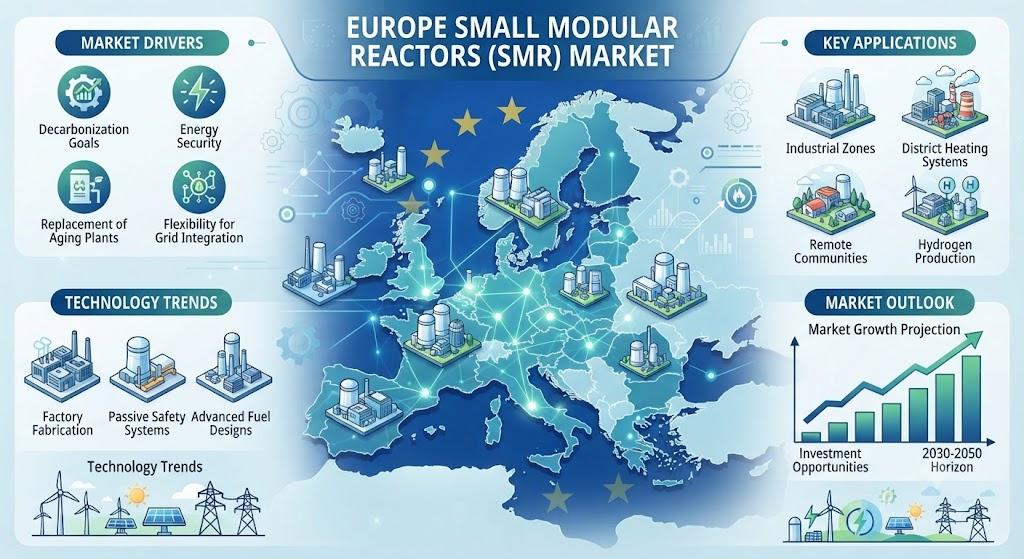
Europe Small Modular Reactors Market Trends
Small modular reactors are attracting growing attention in European energy discussions, but the sector is still developing and its direction remains uncertain. Governments and utilities are weighing energy security, decarbonisation, industrial competitiveness, and the reliability of electricity supply. Several themes are shaping current planning, from standardised manufacturing and cross-border cooperation to fuel security, public engagement, and the challenge of financing early projects.
One important theme is the pursuit of repeatable design and construction. Developers aim to move selected manufacturing tasks into controlled factory environments and reduce the amount of complex work completed on site. If projects use consistent designs and components, experience from early units may improve later delivery. However, the benefits depend on repeat orders, stable specifications, efficient transport, and proven construction methods.
The Europe Small Modular Reactors Market Trends outlook is also influenced by interest in integrated energy systems. SMRs are discussed not only as electricity sources but also as potential suppliers of industrial heat and energy for selected processes. These applications require detailed matching of reactor capabilities, customer demand profiles, safety boundaries, and infrastructure. Not every design will serve every use case.
Another theme is the relationship between nuclear power and renewable generation. Wind and solar capacity can reduce emissions and fuel exposure, while dependable nuclear output may help meet demand during periods of lower renewable production. System value depends on the wider grid, available storage, interconnection, demand flexibility, and operating rules. Technology choices should therefore be evaluated within whole-system planning rather than in isolation.
Regulatory collaboration is receiving attention because developers may seek to deploy related designs in multiple countries. Shared technical learning and clearer processes could reduce unnecessary duplication, but nuclear licensing cannot be reduced to a single European approval. National regulators must account for local laws, site conditions, environmental impacts, emergency arrangements, and public consultation. Harmonisation is most useful when it preserves rigorous independent oversight.
Supply-chain resilience is another emerging priority. Europe may need additional manufacturing capacity for specialised components, nuclear-grade materials, instrumentation, fuel services, and maintenance. Decisions about reactor design will shape which suppliers can participate. Building capabilities takes time, and suppliers need visibility into procurement schedules before investing in facilities, certification, and staff development. Cross-border partnerships could help spread costs and knowledge.
Fuel strategy is increasingly important as countries consider different reactor concepts. Designs can vary in fuel composition, enrichment requirements, fabrication routes, and waste characteristics. Project sponsors need to verify that the required fuel can be sourced under dependable commercial and regulatory arrangements. A technically attractive reactor may face deployment constraints if its fuel pathway is immature or concentrated among too few suppliers.
Financing models are also evolving. Investors and customers need to allocate construction risk, operating risk, and long-term obligations clearly. Possible structures include utility ownership, partnerships, regulated models, and contracted electricity sales. No arrangement removes the need for credible costs and schedules. Transparent risk allocation can improve confidence, while unclear liabilities may delay final investment decisions.
Public trust remains fundamental. Communities may seek clear information about safety, emergency preparedness, water use, transport, waste storage, and local benefits. Engagement that starts before site decisions are final can surface concerns and improve planning. Communication should acknowledge uncertainty rather than present proposed projects as inevitable.
The direction of Europe’s SMR sector will ultimately depend on evidence from real projects. Milestones such as licensing progress, financing commitments, manufacturing readiness, and construction performance matter more than announcements alone. If early units demonstrate safe, reliable, and competitive delivery, interest may broaden. Until then, the most credible outlook recognises both the potential of modular nuclear technology and the substantial work required to establish it commercially.

 Arabic
 French
 Spanish
 Portuguese
 Deutsch
 Turkish
 Dutch
 Italiano
 Russian
 Romaian
 Portuguese (Brazil)
 Greek
