


UK Alzheimer’s Therapeutics Market: NHS Dementia Strategy and Research Investment Underpin 9.7% CAGR
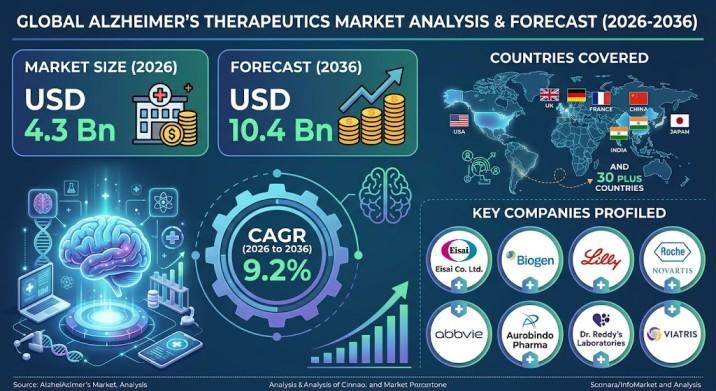
The global Alzheimer’s therapeutics market is projected to reach USD 10.4 billion by 2036, up from USD 4.3 billion in 2026, registering a compound annual growth rate (CAGR) of 9.2% over the forecast period, according to Future Market Insights (FMI). The market was valued at USD 3.9 billion in 2025, reflecting the growing commercial importance of prescription treatments for Alzheimer’s disease.
Increasing demand for symptom-management medications, the development of disease-modifying therapies, and expanding access to specialist neurological care are shaping the market outlook. Pharmaceutical companies are focusing on therapeutic innovation, treatment accessibility, and clinical evidence as healthcare systems explore options for managing Alzheimer’s disease across different stages.
Key companies identified in FMI’s market analysis include Eisai Co. Ltd., Biogen, Eli Lilly and Company, F. Hoffmann-La Roche Ltd., Novartis, AbbVie, Aurobindo Pharma, Dr. Reddy’s Laboratories, and Viatris.
Request a sample report: https://www.futuremarketinsights.com/reports/sample/rep-gb-14497
Key Forecast Highlights
· Market size in 2026: USD 4.3 billion
· Market forecast for 2036: USD 10.4 billion
· Forecast CAGR (2026–2036): 9.2%
· Leading drug class: Donepezil, with a projected 67.7% segment share in 2026
· Leading distribution channel: Hospital pharmacies, with a projected 35.0% share in 2026
· Fastest-growing country: Japan, with a projected CAGR of 12.0%
These forecasts highlight the coexistence of established symptomatic treatments and newer disease-modifying therapies. For industry stakeholders, the opportunity extends beyond drug development to include patient identification, treatment delivery, pharmacy distribution, and reimbursement planning.
Key Market Trends: Innovation, Patient Access, and Treatment Monitoring
The Alzheimer’s therapeutics market is being shaped by three interconnected trends.
Expansion of disease-modifying treatment options: Newer therapies are increasing the importance of early diagnosis and confirmation of treatment eligibility. Pharmaceutical companies must demonstrate clinical value while navigating regulatory and reimbursement requirements.
Continued demand for established oral medicines: Oral therapies remain important for long-term symptom management because they can be administered through familiar prescription and pharmacy channels.
Greater emphasis on treatment infrastructure: Certain disease-modifying therapies require specialist oversight, imaging assessments, and monitored administration. Hospitals and memory clinics therefore play an important role in treatment delivery.
These trends have implications for commercial planning. Manufacturers must assess not only the potential demand for a medicine but also the clinical infrastructure, affordability, and healthcare-system capacity required to support its use.
Regional Opportunities Across Major Markets
Japan is projected to record the fastest growth among the countries highlighted by FMI, with a CAGR of 12.0% through 2036. India follows with a projected CAGR of 11.6%, while Germany is expected to grow at 11.0%.
Other country-level forecasts include China at 10.4%, the United Kingdom at 9.7%, the United States at 9.0%, and France at 8.6%.
These differences create distinct strategic considerations for market participants.
Japan offers opportunities for companies evaluating specialist treatment pathways and access to innovative therapies. India presents potential for established oral medicines and expanded neurological diagnosis, while market development for higher-cost therapies will depend on affordability and access.
Germany and the United Kingdom require attention to national reimbursement and health technology assessment processes. In the United States, coverage criteria and treatment infrastructure influence access to disease-modifying medicines. China represents another important market to assess in light of its patient population and evolving healthcare requirements.
For businesses considering geographic expansion, country-level growth projections should be evaluated alongside regulatory pathways, reimbursement arrangements, local competition, and the availability of diagnostic and treatment facilities.
Competitive Landscape: Leading Companies in Alzheimer’s Therapeutics
Competition in the Alzheimer’s therapeutics market spans innovative biotechnology, established pharmaceutical portfolios, and generic prescription medicines.
Companies identified in FMI’s report include:
· Eisai Co. Ltd.
· Biogen
· Eli Lilly and Company
· F. Hoffmann-La Roche Ltd.
· Novartis
· AbbVie Inc.
· Aurobindo Pharma
· Dr. Reddy’s Laboratories
· Viatris
Eisai and Biogen are associated with Leqembi (lecanemab), while Eli Lilly markets Kisunla (donanemab). These disease-modifying treatments have increased the importance of early-stage patient identification and specialist treatment delivery.
Roche and Novartis bring pharmaceutical research capabilities and broader portfolio expertise to the neurological treatment landscape. AbbVie is another established pharmaceutical participant. Aurobindo Pharma, Dr. Reddy’s Laboratories, and Viatris are relevant to the broader prescription medicine landscape, including established therapies.
The companies listed above are not presented in a verified market-share ranking. Their individual commercial positions vary by product, geography, regulatory status, and treatment category.
Read the full report: https://www.futuremarketinsights.com/reports/alzheimers-therapeutics-market
Strategic Implications for Pharmaceutical Companies and Investors
The projected expansion of the Alzheimer’s therapeutics market creates opportunities across drug development, commercialization, distribution, and healthcare partnerships.
Pharmaceutical manufacturers can prioritize clinical evidence, patient eligibility pathways, and treatment strategies that address practical barriers to adoption. Companies developing disease-modifying therapies should evaluate the requirements for diagnostic confirmation, monitoring, and reimbursement alongside their product strategies.
Generic medicine manufacturers can assess opportunities in established symptom-management treatments, taking into account competition, pricing pressure, and regional prescription patterns.
Hospitals, specialty pharmacies, and healthcare providers can evaluate their capacity to support appropriate treatment delivery. Investors, meanwhile, should consider clinical differentiation, regulatory milestones, market access, and the cost of delivering treatment when evaluating companies in this sector.
The commercial outlook is promising, but market growth will depend on evidence of clinical benefit, affordability, treatment accessibility, and healthcare-system readiness.
Future Outlook for the Alzheimer’s Therapeutics Market Through 2036
The global Alzheimer’s therapeutics market is projected to grow from USD 4.3 billion in 2026 to USD 10.4 billion by 2036, according to FMI, representing a CAGR of 9.2%.
The combination of established symptomatic medicines and newer disease-modifying therapies is reshaping the market’s commercial landscape. As treatment options evolve, pharmaceutical companies will need to align product development with patient needs, clinical evidence, and healthcare delivery requirements.
For manufacturers, investors, and healthcare stakeholders, understanding drug-class trends, regional growth patterns, and treatment-access requirements will be essential to evaluating opportunities through 2036.
Related Reports:
· Auto-Injectors Market - https://www.futuremarketinsights.com/reports/auto-injectors-market
· GLP-1 Obesity Home Delivery Injectables Market - https://www.futuremarketinsights.com/reports/glp-1-obesity-home-delivery-injectables-market
· Digital Colony Counter Market - https://www.futuremarketinsights.com/reports/digital-colony-counter-market
About Future Market Insights (FMI)
Future Market Insights (FMI) is a global market intelligence and consulting firm providing comprehensive market research, competitive intelligence, and strategic business insights across industries. The firm delivers detailed forecasts, technology analysis, and data-driven recommendations that support informed decision-making for manufacturers, investors, distributors, and policymakers worldwide.
For Press & Corporate Inquiries
Rahul Singh
AVP – Marketing and Growth Strategy
Future Market Insights, Inc.
+91 8600020075
For Sales – sales@futuremarketinsights.com
For Media – Rahul.singh@futuremarketinsights.com
For Web – https://www.futuremarketinsights.com

 English
 Arabic
 French
 Spanish
 Portuguese
 Deutsch
 Turkish
 Dutch
 Russian
 Romaian
 Portuguese (Brazil)
 Greek
